STUDIO #334, KRESS CONTEMPORARY — TAMPA, FL
b. 1973, Delicias, Morazán, El Salvador. Lives and works in Tampa, Florida.
Will Hernandez is a Tampa-based contemporary painter whose large-scale narrative works in oil on wood panel confront the most volatile intersections of history, faith, and the eternal human choice between sacrifice and betrayal. Born in 1973 in Delicias, Morazán, El Salvador — a farming community of natural beauty and simple lifestyle that was overtaken by the terror of civil war — Hernandez migrated to the United States in 1981 as a child of seven, having already witnessed with his own eyes death, destruction, despair, and the loss of friends and people he loved. That seven year old boy is where the work begins.
Before establishing himself as a visual artist, Hernandez first gave voice to his experiences through poetry. Writing under his birth name Wilfredo Argueta Hernandez, he authored War Child: Morazán, El Salvador, 1981 — a published poetry collection available through Barnes & Noble. The book recounts stories of his childhood in El Salvador, recapping the untimely and unusual death of his father and the profound impact this had on his life and writing. The influence of coming of age, with little guidance, in a country ravaged by civil war is apparent in nearly every verse — poetry filled with adolescent anger and discovery, as the vision of Delicias as a farming community of natural beauty is overtaken by images of fear, death, and destruction that eventually became commonplace to a young boy learning to be a man.
He wrote the poetry to get the rawness of death he witnessed onto paper — to leave it all behind and to live. But the question that could not be left behind, the question that followed him from Morazán to New Jersey to New York to Tampa, was the one he asked God in his sleep:
That question started the paintings.
Hernandez studied at Saint Peter's College in Jersey City, New Jersey, where he was discovered by and trained under one of the most remarkable artistic figures of the twentieth century — the Jesuit priest, painter, and Vatican restorer Fr. Oscar Magnan (1929–2024).
In the summer of 1985, Fr. Magnan stepped into the Sistine Chapel at the Vatican and joined a team of international experts tasked with restoring the building's famous ceiling. For the next several weeks, he scaled the metal scaffolding and repaired inch by inch Michelangelo's historical frescoes — among the most sacred works of art in human history. His paintings appear in over 40 museums worldwide, including the permanent collections of the Guggenheim Museum, the Metropolitan Museum of Art, the British Museum, the Philadelphia Museum of Art, and the Bibliothèque Nationale in Paris. He is a recipient of awards from the Canada Council, the Guggenheim Foundation, and the Hereward Lester Cooke Foundation.
Hernandez reflects: "I am deeply honored to have been discovered by Oscar Magnan and taken under his tutelage." Magnan painted an oil portrait of his student as Christ — a work that currently hangs in a monastery in the Bronx, New York.
It is a lineage that very few living artists anywhere in the world can claim.
Will Hernandez does not paint political figures. He paints God.
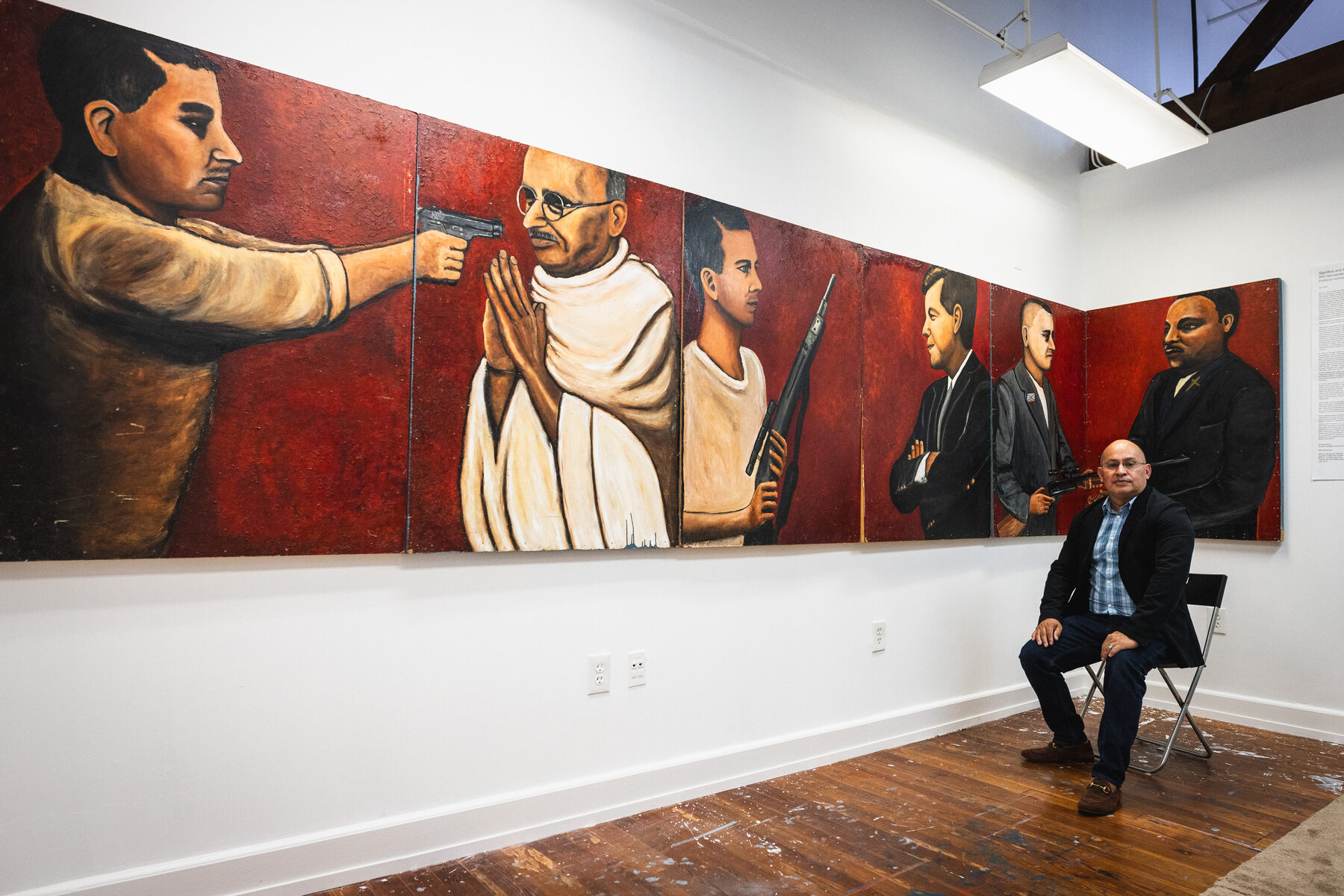
His practice is anchored in what he calls the Judas-Messiah Complex — a sustained philosophical inquiry into the eternal human choice that every person alive faces every day. In his view, history's most defining figures are not political actors. They are spiritual archetypes — men who stood at the crossroads between transcendence and betrayal and made their choice. Kennedy, Gandhi, Lincoln, Martin Luther King Jr. — in Hernandez's hands they are not presidents or leaders. They are resurrections. Oswald, Godse, Booth, James Earl Ray — they are not assassins. They are Judas.
"To me it is you and me. We can all choose which side to be — Judas or Messiah."
His ongoing diptych series Sacrifice and Betrayal pairs these figures across searing red fields that invoke both the altar and the crime scene. The compositions are deliberate in their symmetry, refusing to assign heroism, insisting instead that the viewer confront the moral ambiguity at the center of human history. The red is not blood. It is the moment before the resurrection.
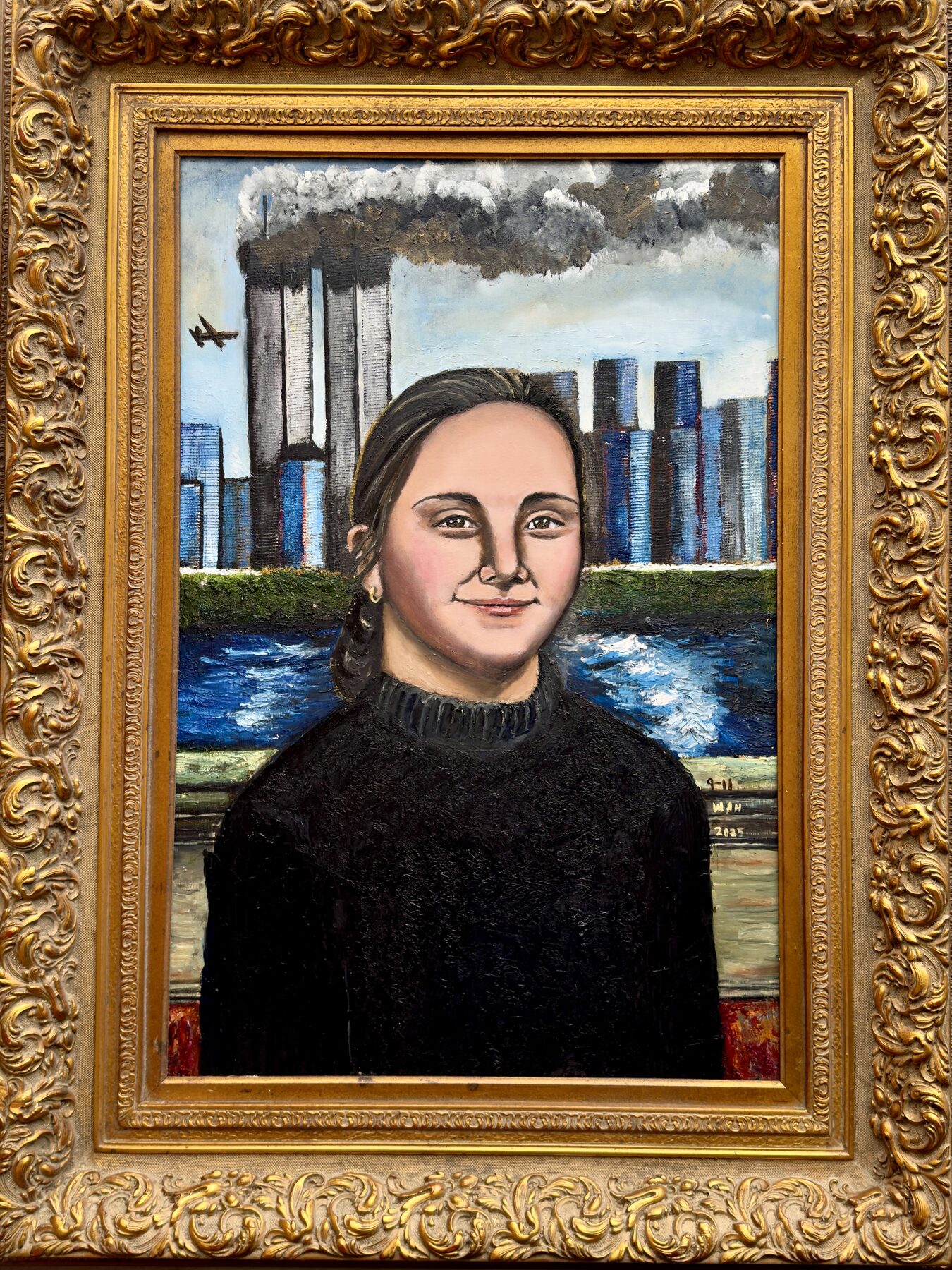
His Mona Lisa 2001 — an oil on wood panel measuring 49 x 30 inches — is a deeply personal tribute to the World Trade Center. The September 11, 2001 attacks on a place he knew intimately moved him to create this work, fusing a portrait of Gabriela with the memory of a place forever lost. The painting transforms personal connection into historical monument. The work was exhibited at Cologne Art Unframed in November 2025 in Cologne, Germany.
His earlier series, I Almost Got Away With It (2014), brought this same unflinching gaze to the American true crime spectacle, depicting figures from high-profile criminal cases in a style that merges tabloid imagery with the gravitas of history painting. The series was featured in a Telemundo television interview and exhibited at Santaella Studios for the Arts, Tampa.
Beyond political iconography, Hernandez's practice also encompasses mythological and cosmic narratives — works such as Hippo Swallowing a Galaxy, Goddess-Hero, and Ali demonstrate the full range of a painter equally at home in the spiritual, the universal, and the deeply human.